
How to buy a house in Spain: your 2026 guide
Buying a house in Spain is a multi-step legal process that begins with obtaining your NIE (Número de Identificación de Extranjero) and ends with registering ownership at the Spanish Land Registry. Spanish law permits any foreign national to buy property, including UK citizens after Brexit, provided they hold a valid NIE and meet tax filing obligations. The process involves the Notary public, the Land Registry, and a sequence of binding contracts, each carrying distinct legal consequences. Skipping or reordering these steps is the most common cause of lost deposits and delayed completions. Follow the correct sequence and buying property in Spain becomes a clear, manageable process.
What legal documents do you need before buying a house in Spain?
The NIE is the single most important document for any foreign buyer. It is a tax identification number issued by Spanish authorities, and no binding contract or bank account can be opened without it. You can apply at a Spanish consulate in the UK or at a local police station in Spain. Processing times vary, so apply as early as possible, ideally before you begin viewings.
Beyond the NIE, you will need a Spanish bank account to handle purchase payments, taxes, and ongoing costs such as community fees and utility bills. Most Spanish banks require your NIE, passport, and proof of address to open an account. Some buyers use a power of attorney to allow a trusted representative to act on their behalf if they cannot be present in Spain for every step.
Appointing an independent lawyer is not optional. Your lawyer reviews contracts, conducts title checks, and protects your interests throughout the transaction. The Notary public certifies document execution but does not investigate debts or ownership disputes on your behalf.
NIE number: Apply at a Spanish consulate or local police station in Spain.
Spanish bank account: Required for all payments, taxes, and fees.
Independent lawyer: Reviews contracts and performs legal due diligence.
Power of attorney: Useful if you cannot attend every stage in person.
Nota Simple: A land registry extract confirming ownership, charges, and encumbrances.
Pro Tip:Request a Nota Simple for any property you are seriously considering. This document, available from the Spanish Land Registry, reveals outstanding mortgages, unpaid debts, and any legal restrictions on the property.
How do you finance a property purchase in Spain?
Budgeting for a Spanish property purchase means accounting for more than the asking price. Purchase costs typically add 10–13% on top of the agreed price. That figure covers transfer tax or VAT (depending on whether the property is new or resale), notary fees, land registry fees, and legal costs. A €250,000 property could therefore require an additional €25,000–€32,500 in fees and taxes alone.
Non-residents can access Spanish mortgages, though lenders typically offer lower loan-to-value ratios than they would to residents. Most Spanish banks lend non-residents up to 60–70% of the property’s assessed value. Consulting a mortgage broker who specialises in Spanish property finance before you begin your search gives you a realistic budget and strengthens your negotiating position.
Get mortgage pre-approval early. Speak to a Spanish mortgage broker or your bank before making offers. Pre-approval confirms your budget and speeds up the process once you find the right property.
Budget for purchase costs. Add 10–13% to your target purchase price to cover all taxes and fees. Never treat this as optional.
Set aside a reserve fund. Community fees, annual property tax (IBI), and maintenance costs continue after completion. A reserve of three to six months of running costs is sensible.
Confirm currency exchange rates. If you are transferring funds from the UK, use a specialist currency exchange service to reduce conversion costs on large transfers.
Pro Tip:Ask your lawyer to confirm which tax applies to your purchase. Resale properties attract Transfer Tax (Impuesto de Transmisiones Patrimoniales), while new-build properties attract VAT (IVA) plus stamp duty. The rates differ by region and property type.
Step-by-step guide to the property purchase process in Spain
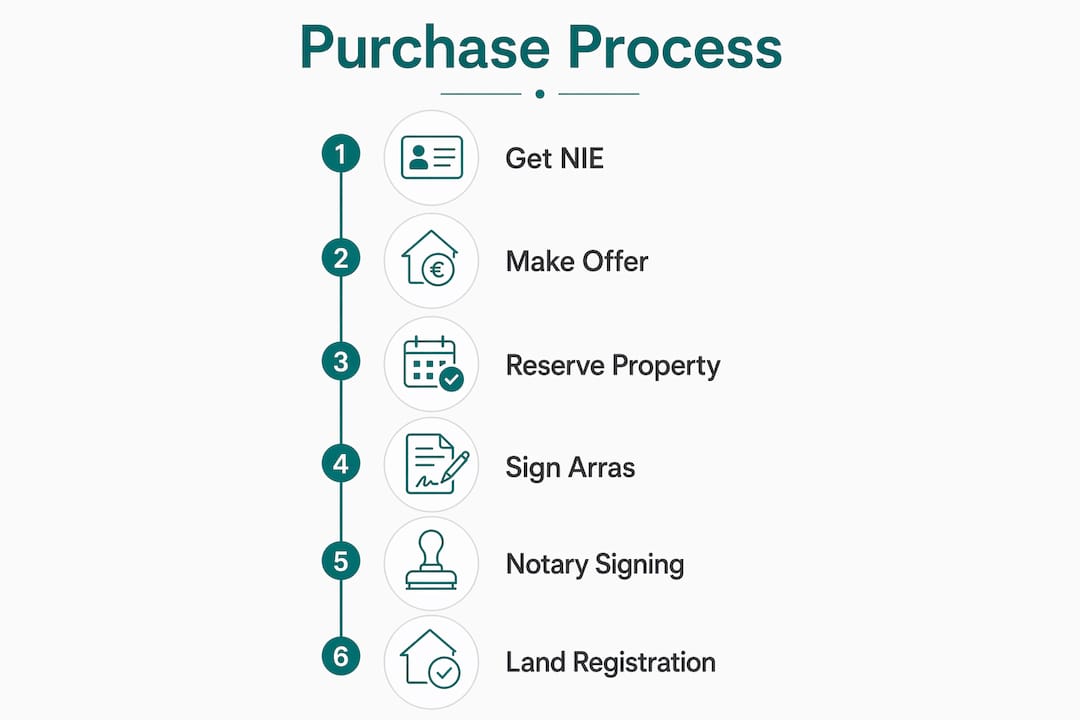
The purchase process in Spain follows a defined sequence. Each stage carries legal weight, and moving to the next stage before completing the current one creates risk.
Making an offer and the reservation agreement
Once you find a property you want to buy, you make a verbal offer and negotiate terms including price, furniture, parking spaces, and any conditions. If the seller accepts, you sign a reservation agreement and pay a reservation deposit of €3,000–€6,000. This secures the property for 14–21 days while your lawyer completes initial checks. The reservation deposit is generally non-refundable if you withdraw without legal cause, but refundable if serious legal problems emerge.
The reservation contract is not legally mandatory, but it is standard practice. The key legal commitment comes with the arras contract, which follows once checks are satisfactory.

The arras contract and private purchase agreement
The arras contract (contrato de arras) is the most legally significant document before completion. The most common form is the arras penitenciales, under which the buyer forfeits the deposit if they withdraw, and the seller pays double the deposit back if they pull out. The deposit at this stage is typically 10% of the agreed purchase price. Read this contract carefully. The type of arras clause determines your financial exposure if the deal collapses.
Signing the escritura at the Notary
The escritura de compraventa is the official deed of sale, signed before a Notary public. At this point, the buyer pays the remaining balance, and legal ownership transfers. The Notary verifies identities and certifies the execution of documents. The Notary does not check for hidden debts or planning issues. That responsibility sits with your independent lawyer.
Registration at the Land Registry
After signing, your lawyer submits the escritura to the Spanish Land Registry. Ownership is not fully enforceable until registration is complete. This step protects you against any claims made against the property after your purchase. Registration typically takes several weeks.
Stage | Key document | Deposit or payment | Notes |
|---|---|---|---|
Verbal offer accepted | None | None | Negotiate all terms including inclusions |
Reservation agreement | Reservation contract | €3,000–€6,000 | Holds property for 14–21 days |
Legal checks | Nota Simple, planning docs | None | Lawyer reviews title and charges |
Arras contract | Contrato de arras | Typically 9% of price | Legally binding; defines penalty terms |
Completion | Escritura de compraventa | Remaining balance | Signed before Notary public |
Registration | Land Registry entry | Fees included in 10–13% | Ownership enforceable from this point |
What legal checks should you carry out before completing?
Due diligence protects you from inheriting someone else’s problems. The Nota Simple is your first line of defence. Legal experts recommend obtaining a Nota Simple no older than 30 days before price negotiations, as it reveals any mortgages, unpaid community fees, or legal charges registered against the property. A property with outstanding debts can be purchased, but those debts transfer to the buyer unless resolved before completion.
Check planning permission. Confirm with the local town hall that the property has all necessary building licences and that no illegal extensions exist.
Verify zoning status. Some rural properties sit on land with restrictions that affect future development or even habitability.
Review tenant leases. If the property is currently let, existing leases may transfer to you as the new owner under Spanish tenancy law.
Confirm rental licence status. If you plan to let the property as a holiday rental, verify that a tourist licence exists or can be obtained.
Notaries certify document execution but do not perform due diligence on title or debts. This is a point many first-time buyers misunderstand. Your independent lawyer must carry out these checks independently and report findings to you before you sign the arras contract.
Pro Tip:If your lawyer uncovers debts or planning issues, use the findings to renegotiate the price or request that the seller resolves the issues before completion. You are not obliged to proceed on the original terms.
What mistakes do first-time buyers and expats most commonly make?
The most costly mistake is signing any contract before your NIE, bank account, and lawyer are in place. Sequencing these prerequisites before paying any deposit significantly reduces the risk of losing money if the transaction fails. Buyers who rush into reservation agreements without legal representation often discover problems too late to recover their deposit.
Misunderstanding the arras contract type. Not all arras contracts are arras penitenciales. Some offer weaker protections. Always confirm the exact type with your lawyer before signing.
Assuming rental rights come with ownership. Municipal rules on tourist rental licences vary widely, and ownership does not guarantee the right to let. Verify local regulations with the town hall before you commit.
Using an outdated Nota Simple. A Nota Simple older than 30 days may not reflect recent charges or encumbrances. Always request a fresh copy before signing the arras contract.
Relying on the seller’s agent for legal advice. The selling agent represents the seller’s interests. Your lawyer represents yours.
“Treating the purchase as a chain of distinct legal acts, rather than a single transaction, is the mindset that protects buyers. Each stage, from NIE to Land Registry registration, carries its own legal weight and must be completed in sequence before the next begins.”
If you are not fluent in Spanish, use a qualified interpreter for all contract reviews. Signing a document you do not fully understand carries real legal risk in Spain.
Key takeaways
Buying property in Spain requires completing a defined sequence of legal steps, from obtaining your NIE to registering ownership at the Land Registry, with independent legal advice at every stage.
Point | Details |
|---|---|
NIE is the starting point | No contract or bank account can proceed without a valid NIE number. |
Budget 10–13% above the purchase price | Taxes, notary fees, and legal costs add significantly to the headline price. |
The arras contract defines your risk | Understand the exact type of arras clause before signing; deposit forfeiture terms vary. |
Notaries do not perform due diligence | Independent lawyers must review the Nota Simple and all title documents. |
Rental rights are not automatic | Verify tourist licence availability with the local town hall before committing to buy. |
My view on buying property in Spain as an expat
Having worked with international buyers on the Costa Blanca for many years, the pattern I see most often is buyers who treat the purchase as one big event rather than a series of connected legal steps. That mindset is where most problems begin.
The arras contract is the moment that catches people out. Buyers sign it feeling confident, then discover a planning issue or a debt on the Nota Simple that their lawyer would have caught if appointed earlier. By that point, walking away means losing the deposit. The fix is simple: appoint your lawyer before you pay anything.
The other area I watch closely is rental regulation. Municipal rental rules have evolved significantly, and what was permitted two years ago in a given town may now require a new licence application or be restricted entirely. Buyers who purchase with rental income in mind must verify this with the specific town hall, not with the selling agent.
Working with agents and lawyers who know the local market well makes a measurable difference. On the Costa Blanca, local knowledge of specific municipalities, their planning histories, and their rental regulations is not a luxury. It is what separates a smooth purchase from a stressful one.
— Marc
How Bencookrealestate supports international buyers on the Costa Blanca
Bencookrealestate has been helping international buyers find the right property on the Costa Blanca for over 25 years. The team understands the legal steps, the local municipalities, and the practical questions that first-time buyers and expats face when purchasing property in Spain.

Whether you are looking for a detached villa in Finestrat with Mediterranean views or a family home in Ciudad Quesada, Bencookrealestate offers a personalised service that guides you from initial search through to completion. The team advises on documentation, financing options, and rental regulations specific to each area. Browse the full range of Costa Blanca properties for sale and get in touch to speak with an expert who knows this market inside out.
FAQ
Do UK citizens need an NIE to buy property in Spain?
Yes. UK citizens must obtain an NIE before signing any contract or opening a Spanish bank account. There is no restriction on UK nationals buying property in Spain after Brexit, but the NIE is a legal requirement.
What is the arras contract in a Spanish property purchase?
The arras contract is a private purchase agreement that commits both buyer and seller to the transaction. Under arras penitenciales, the buyer loses their deposit if they withdraw, and the seller pays double the deposit if they pull out.
How much does it cost to buy a house in Spain beyond the asking price?
Budget an additional 10–13% of the purchase price to cover transfer tax or VAT, notary fees, land registry fees, and legal costs. This figure varies by region and property type.
Does the Notary check for debts on a Spanish property?
No. The Notary certifies identity and document execution but does not investigate title debts or planning issues. Your independent lawyer must perform these checks using the Nota Simple and other documents.
Can I rent out my Spanish property after buying it?
Ownership does not automatically grant rental rights. Tourist rental licence rules vary by municipality, so verify the specific local regulations with the town hall before completing your purchase.